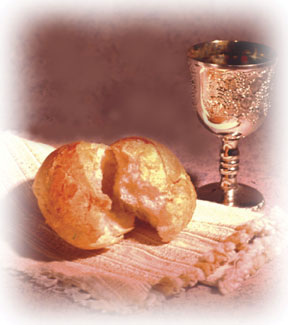
Like Baptism, Communion is a Christian ritual that was instituted by Jesus Christ and practiced by his followers from the very beginning. Some refer to it as a sacrament. We generally refer to it as an ordinance. Communion is a corporate, symbolic act of remembrance of the redemptive work of Jesus Christ. It involves the receiving of a piece of bread and a sip of wine (or grape juice). These elements represent the body and blood of the Son of God, Jesus Christ, whom we worship and follow. By receiving both the bread and the "fruit of the vine", Christians are encouraged to enter more fully into the realization of Christ's suffering for them, and are strengthened by that act, together with the church.
How Important is it?
This question is the same as asking the question, how important is it to my marriage to tell my wife that I love her? It is the Christian's desire to fulfill the desires of the One Who loves us. He is the One who said, Whoever has my commands and obeys them, he is the one who loves me (Jn 14:21).
Looking at the question from a different angle, how significant is this practice?
Various Christian traditions have viewed this quite differently. Very early in church history, some started taking the meaning of Jesus` words quite literally as he held the bread and said “This is my body” and “This is my blood” with reference to the wine. Thus you have a view known as transubstantiation, the belief that the elements miraculously and mysteriously change into the actual flesh and blood of Jesus Christ. You can imagine that those elements are treated very reverently and are offered up as a re-presentation of the once-for-all sacrifice that Jesus offered for us. People who hold this view also believe that because the bread and wine are actually and literally the flesh and blood of the Lord Jesus, they are obligated to worship it. They also believe that grace is communicated to the participant. Grace is understood as a divine enablement to resist sin in one's life and adds to the merits that are necessary to attain ultimate salvation.
The view we believe to be biblical is known as the memorial view. That is, we believe that the language that Jesus used was very naturally a figure of speech. In holding up the bread, Jesus said, "This is my body". That is no different than holding up a photograph of one's spouse and saying, "This is my wife." What is meant is, "This is a depiction of my wife". No one believes that the substance that the photo is made of (paper, pixels and ink) somehow changes into the substance that a person is made of. The bread and wine are symbols, meant to represent Jesus Christ himself. We believe that grace is communicated to the participant, not magically through the bread and wine, but in the act of prayerful meditation and in our obedience to Christ.
Who are the Participants in Communion?
Communion is based on the Last Supper that Jesus had with his disciples before he was arrested, tried and executed on a Roman cross. The Last Supper was the Passover meal that Jewish people celebrate every year as a memorial of the exodus event. In this memorial event the Jewish people remember that they were once in bondage as slaves to another power, but had been redeemed by God's mighty hand of deliverance. Through the instrumentality of a lamb that was slaughtered for them, the blood of which was spilled and applied to each Jewish household, judgment was averted.
In the same way, those who may participate in the act of Communion are people who live in the realization of redemption by the sacrificial death of the "lamb of God who takes away the sin of the world". It makes no sense at all and it is not biblically permissible that people take part who do not self-identify as followers of Christ. But individuals need to assume responsibility for this decision, (except in matters of church discipline) because we cannot be a judge of the heart to decide who is a true believer and who is not. Thus we observe an "open table" where all professing and self-examined Christians are welcome.
What about partaking in an unworthy manner?
An examination of the context of this term, unworthy manner in 1 Corinthians 11 will show that the Apostle Paul's concern was not that believers were partaking who felt unworthy. We are all unworthy in that sense. The unworthy manner that Paul describes in his Corinthian epistle had to do with the fact that Communion was not being held in the spirit in which it was intended. They were using the occasion as an excuse to party and actually get drunk.
What about children?
We realize that children can and do understand redemption at an early age. We encourage children under the age of 12 to be seated beside their parents during a Communion service. It is the parents’ responsibility to determine whether that child receives Communion in the spirit that is intended. This would mean not allowing a child to partake simply because a parent doesn't want their child to feel excluded, or simply because a child is curious. Those who pass the elements should not be responsible for making these decisions.
How frequently should we hold Communion?
The Bible gives us no prescription. It only assumes that we do it regularly. Jesus said, "As often as you do it... do this in remembrance of me." (1 Cor 11:26) The disciples seemingly did it daily in the early chapters of Acts. Later we see that they did it on a weekly basis, and it became a core part of their corporate life of worship. We routinely do it on a monthly basis, but are not bound or limited by any scriptural constraints. If we want to do it more frequently, we certainly can.
Why do we use grape juice instead of wine?
Firstly, wine in the mid-east was fermented grape juice. We suspect that whether it is fermented or not matters little to the Lord. It does matter that there may be individuals in the congregation who conscientiously avoid any alcoholic beverage out of conviction or due to a former life of alcohol abuse. Therefore, in order to avoid tripping anyone up, we serve grape juice.
Secondly, we live in a culture that has in its history regarded any drinking of alcoholic beverages as sinful. This is so deeply embedded in the conscience of some that is becomes a violation of conscience for them.
“Be careful, however, that the exercise of your freedom does not become a stumbling block to the weak” (1 Cor. 8:9).
What shall I think or meditate on while this service takes place?
- First, we are to be sharing in the reality of who and what Jesus Christ really means to us in all the fullness of His life and work on our behalf—righteousness, sanctification, and redemption; acceptance, significance, and ability to live for the Lord and others. Think about what Jesus Christ means to you because of His sacrifice.
- Second, as a fellowship, Communion is a sharing together with one another. It is a time when together, as we pass the elements, we are demonstrating our common faith, commitment, concerns, love, devotion to Christ and the ministry and life to which He has called us.
- Third, the observance of the Lord's Table should also be a time for examination. It should be a time for personal examination and evaluation of our loves, aspirations, values, devotion, relationships, pursuits, and of our lives in general.
- Last but certainly not least, it is a time of confession. Self examination is a good thing. Ask the Holy Spirit to reveal to your conscience anything that requires cleansing. And determine, as the Lord brings these matters to light and as you confess them, that you will do what it takes to make them right.
If you have any questions or need further clarification on this topic, please email werner1950@gmail.com